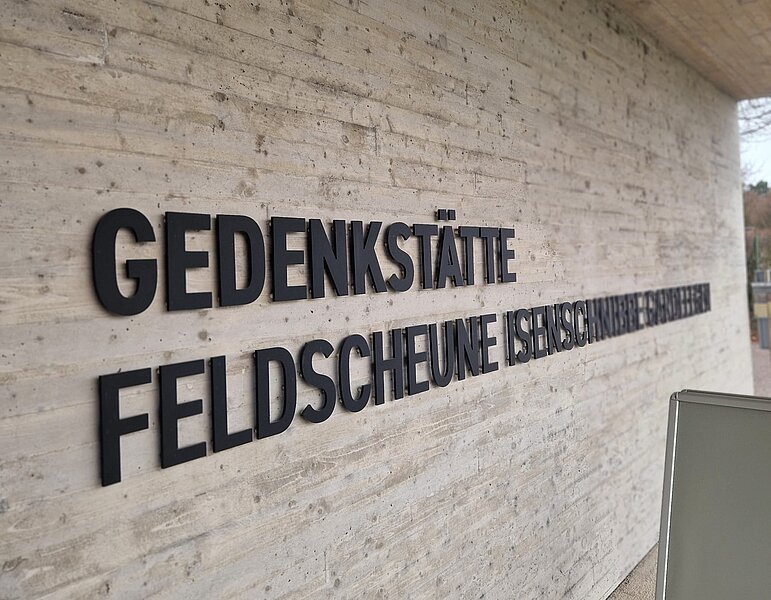
How can remembrance culture be made even more accessible and inclusive? This was the question addressed by the Kompetenzzentrum Inklusive Bildung Sachsen-Anhalt (KIB) during a visit to the Isenschnibbe Feldscheune Memorial near Gardelegen on 24 March 2026. At the invitation of the memorial site, the entire KIB team visited Gardelegen to learn about the educational programmes from an inclusive perspective and to reflect on them with regard to barriers and possible further development.
The visit to Gardelegen had been preceded by an initial meeting on the Stendal campus. The Isenschnibbe Feldscheune Memorial had contacted KIB because it would like to make its educational programmes more inclusive in the medium term. One reason for this is that the memorial is increasingly being visited by classes from special needs schools and groups of residents from Lebenshilfe.
Against this background, the KIB team was invited to visit the memorial site and to look at the existing programmes from the perspective of experts by experience. The aim was to identify possible barriers, examine accessibility and enter into a joint discussion about how remembrance and historical-political education can be made accessible to even more people.
Extensive insights into educational work, the site and the exhibition
During the approximately four-and-a-half-hour visit, the KIB educational specialists and the team gained a comprehensive insight into the work of the memorial site. Among other things, the educational programmes and workshop formats were presented. The team also explored the outdoor area together, received background information on the history of the site and, finally, took an in-depth look at the exhibition.
The visit was accompanied by Jacob Beuchel, educational staff member at the memorial, and Stefan Winzer, director of the memorial. Both conveyed the historical background with great openness, commitment and impressive expertise. Complex contexts were explained in an accessible way, questions were answered in detail, and the joint reflection made it clear that KIB’s perspectives were explicitly welcomed.
A place of remembrance for a Nazi-era crime
The Isenschnibbe Feldscheune Memorial commemorates the Gardelegen massacre. On 13 April 1945, 1,016 concentration camp prisoners from different countries were murdered there in a field barn. Today, the memorial is an international place of remembrance, information and encounter. It combines commemoration, historical learning and educational work at a site that stands in a particular way for the crimes of National Socialism.
For this reason, the question of accessibility and participation is especially important here. Remembrance culture should be open to as many people as possible. This includes not only structural accessibility, but also the question of how content is communicated and what kinds of access different visitors need.
Modern exhibition and openness to further steps
The exhibition itself also left a strong impression on the KIB team. It is modern in design, clearly structured and provides a comprehensible approach to a historical event that is difficult to confront. Especially at a place like this, sensitive, understandable and accessible communication is of great importance.
The visit also showed that the memorial has already created important conditions for accessibility. The grounds and exhibition rooms are accessible, and an accessible toilet is also available. At the same time, during the final evaluation, the memorial team showed great interest in further suggestions on how accessibility and participation can be considered and implemented even more consistently in the future.
An important signal for inclusive educational work
For KIB, the invitation to Gardelegen is a strong signal. The fact that a memorial site and a place of historical-political education is actively approaching the Kompetenzzentrum and involving the expertise of people with disabilities in the further development of its own programmes shows that participation and accessibility are increasingly becoming a focus in many areas of society.
From KIB’s point of view, the visit clearly demonstrated how important it is to consider accessibility not only in structural terms, but also in educational communication. This is precisely where the Kompetenzzentrum contributes its experience: with educational specialists as experts by experience and with the aim of helping to shape participation in education and society in a concrete and practical way.
KIB would like to sincerely thank the memorial site for the invitation, the great openness and the intensive exchange on site. The cooperation with the Isenschnibbe Feldscheune Memorial shows how valuable it is when institutions actively consider inclusion and specifically involve the perspectives of people with disabilities.